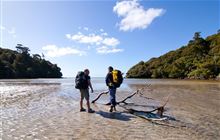
Rakiura Track
Stewart Island bush and beaches
Overview
Escape on an island adventure - relax and unwind in the peaceful surroundings with the bush, birds and beach at your side.
Highlights
Into the Bush
Ancient rimu and totara forest
Muddy Bliss
Robins and tomtits on the track
Home to Oban
Kiwi calls the night before and final coast views
Walk sections
- 1
Oban township to Lee Bay
Along the coast through Horseshoe Bay to the official Rakiura National Park entrance at Lee Bay.
5 km
1h 30m
- 2
Lee Bay to Port William Hut
Follow the coast to Little River (crossed by bridge), then around Peter's Point and on to Maori Beach. At low tide, walk around the beach.
8 km
3h 30m
- 3
Port William to North Arm Hut
Backtrack the 40 min to the Maori Beach turnoff, then through milled and virgin podocarp forest. Can be very muddy — gaiters and tramping poles recommended.
13 km
6h
- 4
North Arm to Fern Gully car park
Sidles from North Arm to Sawdust Bay (operating sawmill 1914-18), through rimu and kamahi forest. Follows the former Kaipipi Road.
11 km
4h 15m
Day-by-day itinerary
- 1
Day 1
3h
Into the Bush
ObanPort William Hut
Distance
8 km
Elevation gain
200m
Est. time
3h
Leave the only town on Stewart Island and head into ancient podocarp forest.
Ancient rimu and totara forest
- 2
Day 2
4h 30m
Muddy Bliss
Port William HutNorth Arm Hut
Distance
13 km
Elevation gain
300m
Est. time
4h 30m
Descend into North Arm — the track is famously muddy but the birdlife extraordinary.
Robins and tomtits on the track
- 3
Day 3
3h 30m
Home to Oban
North Arm HutOban
Distance
11 km
Elevation gain
150m
Est. time
3h 30m
Return through the coastal forest to the ferry wharf at Oban.
Kiwi calls the night before and final coast views
Points of interest
Chain Link Sculpture
Entrance to Rakiura National Park at Lee Bay.
Maori Beach Sawmill
Rusting steam boiler and other remains of the 1900s-1931 timber milling enterprise.
Paterson Inlet Tidal Flats
New Zealand dotterel, oystercatchers, herons and godwits inhabit the tidal flats.
Rakiura Tokoeka Habitat
Stewart Island brown kiwi can be heard calling at night near the huts.
Huts on this walk
- Night 1HutSleeps 24
Port William Hut
BunksPit toiletsCoastal - Night 2HutSleeps 24
North Arm Hut
BunksPit toilets
Fees & pricing
Prices per person, per night. NZ rates require proof of eligibility.
Hut fees
| Date range | Adult NZ | Adult Intl | Child | Infant |
|---|---|---|---|---|
| Peak: 1 Oct – 30 AprPeak | $44 | $66 | $22 | Free |
| Shoulder: 1 May – 30 Jun | $38 | $38 | $19 | Free |
| Off-peak: 1 Jul – 30 Sep | $31 | $31 | $15 | Free |
Campsite fees
| Date range | Adult NZ | Adult Intl | Child | Infant |
|---|---|---|---|---|
| Peak: 1 Oct – 30 AprPeak | $19 | $28 | $9 | Free |
| Off-peak: 1 May – 30 Sep | $6 | $6 | $3 | Free |
Getting there
Start point
Lee Bay
5 km — Oban
5 km from Oban — official Rakiura National Park entrance.
End point
Fern Gully car park
2 km — Oban
2 km beyond the Rakiura National Park Visitor Centre.
Know before you go
Always check track conditions and weather forecasts before you set out.
Deep mud
Track between Port William Hut and North Arm Hut can have mud above boot height. Gaiters recommended; tramping poles useful.
Changeable Stewart Island weather
Strong winds, hail and heavy rain can occur any time of year.
What to take
Personal equipment
- Backpack 40-60L
- Waterproof pack liner
- Sleeping bag (3-4 season)
- First aid kit including blister treatment
- Survival kit (blanket, whistle, paper, pencil, high-energy snack)
- Torch/flashlight and spare batteries
- Booking confirmation and ID
- Earplugs for communal bunkrooms
- Distress beacon
Cooking & food equipment
- Drink bottle 1-2L
- Eating and cooking utensils
- Gas cooker and fuel
- Matches/lighter (waterproof container)
Toiletries
- Insect repellent and sunscreen
- Personal medication (antihistamine for wasp allergies)
Clothing
- Tramping boots or firm footwear
- Wool/polypropylene socks
- Quick-dry shorts
- Wool/polypropylene base layers
- Mid-layer fleece
- Waterproof raincoat with hood
- Wind-/waterproof overtrousers
- Warm hat and gloves
- Sunhat and sunglasses
- Warm sleeping layers
Food
- Lightweight high-energy meals + spare day
- Rodent-proof food storage
Optional
- Gaiters
- Lightweight hut shoes
Nature, history & culture
History
Port William / Potirepo
Maori established hunting camps (kaika) at Port William/Potirepo, site of the early settlement of Pa Whakataka. In the 1800s used by sealers, whalers and a Shetland Islander settlement.
History
Whaling at Paterson Inlet
Sheltered waters used early in the 19th century by whaling boats. In the 1920s-30s the Norwegian Whaling Company ran a repair base in Prices Inlet for Antarctic chaser boats.
Nature
Diverse forest
Mainly rimu and kamahi forest with tree ferns, ground ferns and perching orchids. Rata more common at higher altitudes.
Reviews
No reviews yet
Be the first to share your experience.
Walk it: step-through map
Plan this Great Walk
Trips are private by default. Share when you're ready.
Content from DOC (CC BY 4.0) — used with permission.